Click to enlarge
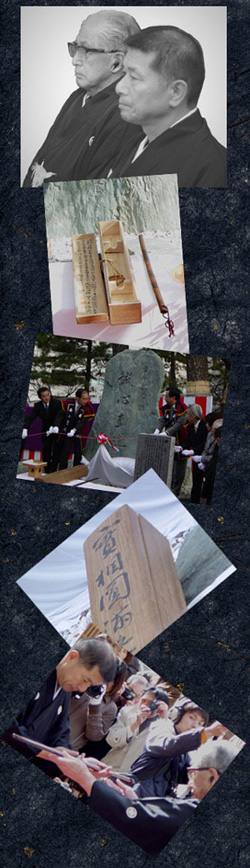
Miyamoto Musashi Fujiwara no Genshin Iwami Toshio Gensho (Harukatsu) Kajiya Takanori
|
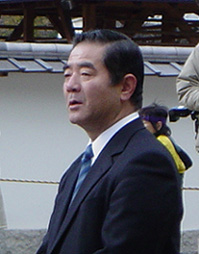
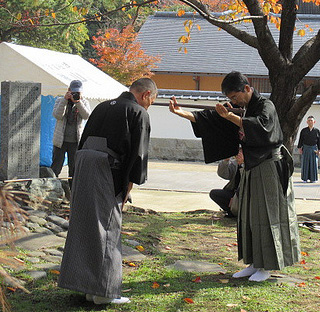
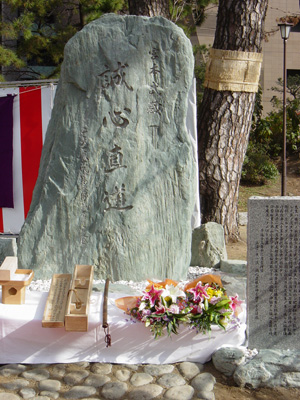
The ceremony was opened by Colin Hyakutake-Watkin, a menkyo holder of the ryu with a ceremony of Honzan Shugenshu and Choken Batto Jutsu Kageryu. Various speeches were given by dignitaries welcoming the ryu back to Kokura. Among these was one by the present generation descendant of Musashi's son Miyamoto Iori. he spoke of the well documented history of Musashi living in Kokura. His third son was a retainer of the Lord Ogasawara Tadazane. r As The appointed new Soke was a resident of Kokura it was the wish of the family that the hombu would now return to Kokura. The inuaguration was finalized by an embu of the Ito and Nito Seiho between the 10th headmaster and his succesor To this day the area is has been used for embu and ceremonial purpose of the Ryu. With relation to the above picture on 24th of November 2003 a new succesor and 12th Soke was appointed. The new and official 12th Soke is now Kajiya Takanori. |As for the past. One of the Menkyo holders Kiyonaga Fumio left the hombu to start his own group separate to Imai Soke back in 2004. Within that group was also the Taiwan representative and menkyo holder Chin Kin. Kiyonaga Fumio died in November 2008 preceding Imai Soke. This group then leaderless could not return to Imai Soke and sought recognition elsewhere. They turned to Gosho Motoharu a Shihan of the Sekiguchi ryu. The Sekiguchi Ryu who had previously been connected with the 8th Sohke Aoki Kikuo. Gosho Motoharu like many of us had previously assisted Imai Sohke. He can be seen on old Nippon Budokan video with Imai Sohke. He also assisted Soke on an Australian seminar. Over the years many of us have had the priviledge to assist Soke myself included. But this does not automatically make me a successor. Obviously the only person that can designate a 12th successor is the 11th one. If every assistant became a Soke? We would have 50 Soke by now. Gosho motoharu then passed away in October 2012. The next person to follow him was a Yoshimochi Kiyoshi who was inuagerated by the Oita Ken Kendo Federation. Yochimochi Kiyoshi died January 2020 leaving the group leaderless as stated on his own internet bio. So hopefully this saga has now come to and end unless someone will try to make up yet another line to try and claim credibilty.
At that particular time I was Koho Bucho of the ryu. I feel that I should post details online to make the matter clear being one of the only people that was privy to to what took place. My other reason for doing so is remembering how devastated Soke was when his trusted Menkyo kaiden left the hombu. Also I am disgusted at the disrespect that has been shown to Soke since he passed away. A distinct lack of Budo Seishin that leaves one wondering why some even bother to practice and study Musashi's philosophy.
Musashi's wish was to perpetuate his art to three sucessors among a thousand students around 1640. To Terao Magonojo, his younger brother ky Kyumanosuke and to Furuhashi Sozaemon. He considered Terao Magonojo to excel in technique but lack in reflection. Furuhashi Sozaemon excelled in reflection but lacked technique. Magonojo recieved the Gorin no Sho on the instructions that he should read it and burn it. borrowed it fora few days and on the the orders of the Lord Hosokawa Mitsuhisa he made two copies. One for Hosokawa and one for himself that he transmitted under the name of Ihon Gorin no Sho. The best known artifact today is the Hosokawa copy. After the death of Musashi Terao Magonojo appealed to Miyamoto Iori to take over the ryu. Miyamoto refused saying it was his father wish that his student should become the new leader.Terao Magonojo later yielded the role of succesor to his younger brother Terao Kyumanosuke who had recieved the Hyoho san from Musashi. It was Kyumanosuke that transmitted to his students this document with seven added instructions called the Hyoho Shiji ni Kajo.a |
||||||||