| Although
the Ryu is not in itself a part of any religious order, it adheres to
religious convictions on a traditional family basis.
Mihashira Jinja one of Yanagawas
major shrines is dedicated to the Tachibana Clan. They and the Kageryu
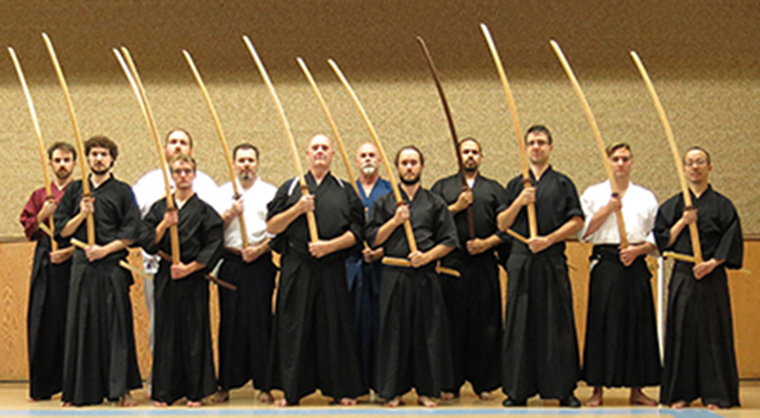
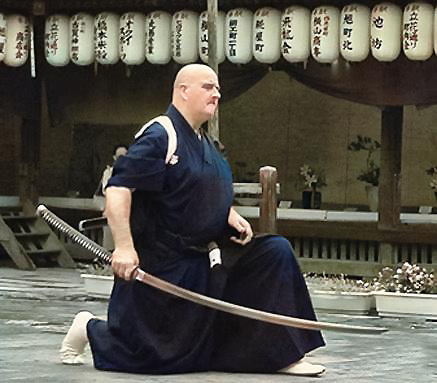
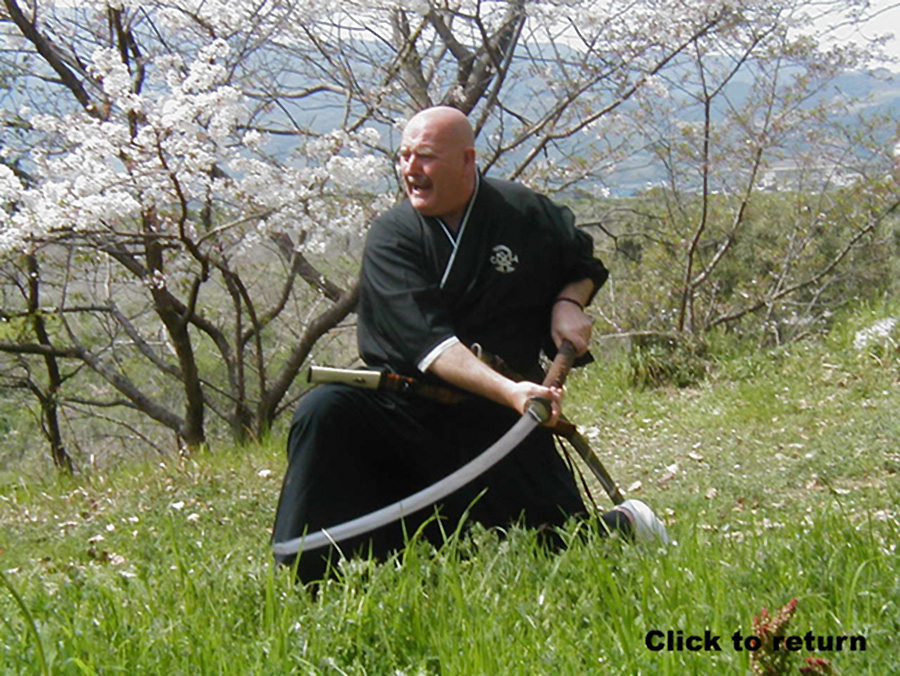
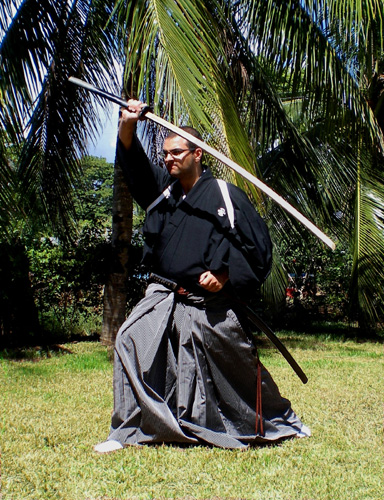
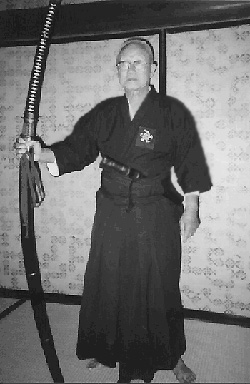
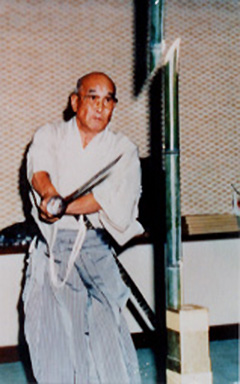
observe and always participate in religious events. Yearly Hono-Embu.
Really rather embarrassing having to put my own pictures on the net.
But then again I am the only one that does these embu now.
|
PURPOSE:
Many years ago, if anyone went into another persons house wearing
a long weapon it was not to sit down and drink tea! This not mean
to say that a long sword cannot be used indoors. The value of
a Japanese sword as a thrusting weapon receives little merit nowadays.
There are many techniques within
the Ryu that use these techniques, For example a thrusting cut
under the armpit between the legs or up into the cranium through
the chin all produce fatal results. There are other benefits to
using the shorter sword indoors apart from cutting. |
|
The blade shown
on the previous page is known as a Ma kiri.
This translates as a door or devil cutter.
A slicing action through
Fusuma paper doors allows one to gain quick entry into
inner rooms of a building.
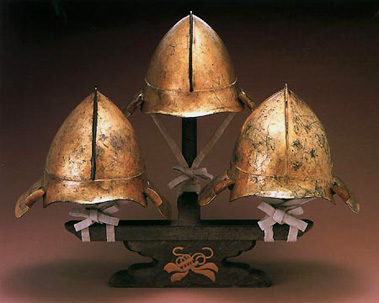
Gusoku Armor of Mogamido type, covered
with Crepe Leather with Double Ring design do. Height.37.0Wt.12.0kgWorn
by Tachibana Muneshige(1569-1642)16th-17th century, Momoyama period.
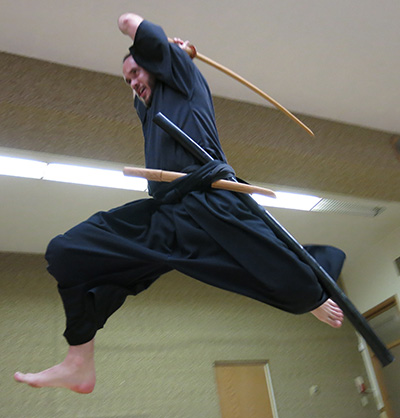
Kaiin, Nathan Morrison in the classic Ukebarai waza
spinning to the rear to parry and following the opponent as he
runs away to cut him down. |
|
Despite
rigorous training in Kage-ryu, exponents encouraged to study more
than just swordsmanship, and practice other traditional arts.
Demonstrations of the Kage-ryu include shakuhachi,
shigin, (Japanese singing), and the mikkyo
(esoteric practices) and the jingai
(triton shell horn) of the Honzan Shugenshu (a school of Shugendo
or Yamabushi practices from Kyoto) Black joba-hakama
and uwagi with han-juban
are worn for everyday practice. White uwagi in the warmer months.
Kaiin are required to wear montsuki-hakama
bearing the family crest of the Tachibana clan for formal events.
The crest of intertwined Ginko Leaves shown below.
The Ryu has survived to this day
with no rank or gradings. However, holding grades or rank in other
forms of sword arts is beneficial if one wishes to become a member.
There are certain fundamental elements that encompass all of these
arts. |

|
I was suggested that I join Nippon
Kobudo Kyokai with The Kageryu. This would indeed give us national
recognition. But the ryu has survived to this day despite efforts to
stop it by authorities, not because of help. Like most Kobudo Ryu there is no
hereditary succession. We will continue
into the future handing on what we know from teacher to student with as
little adaptation as possible from what we have been taught.
|
Yanagawa Kobudo
Shinkokai is associated with the Nippon Todo Renmei, a batto
jutsu organization.
Right, Nakazawa Rin. Deceased
President of the Nippon Todo Renmei and Kyudai Sohke of the
Taiko Konoha Ryu (Hideyoshi fallen leaf school of
swordsmanship). Vice
President is the famous Hayashi Kunishiro Sensei of Wakakoma
Pro. |
 |

 |
Kaku Obi no Musubikata |
|
Home |
|
|
|